Turkey property market 2026: trends and outlook for buyers
What official data says about Turkey's housing market in 2026 – sales, prices in real terms, mortgages and foreign buyers – and the factors that will shape the next stage. No forecasts, only drivers and scenarios.

Buyers often ask where Turkish property prices are heading. Nobody can answer that with certainty, and any guide that promises a direction should be read with caution. What can be done is to read the current data carefully and identify the forces that will move the market. This guide does that for 2026 and is meant to complement our overview of property in Turkey and the current price levels in property prices in Turkey 2026.
In brief
- Home sales hit a record 1,688,910 in 2025 but were 7.2% lower year on year in January–September 2026 (TÜİK).
- Prices are rising in lira but falling in real terms: −5.7% year on year in September 2026 (TCMB).
- Mortgaged sales rose 24.7% in January–September 2026, from a low base.
- Foreign buyers account for about 1.5% of sales; Istanbul and Antalya together take most of that demand.
Where the market stands
| Indicator | Latest figure | Source |
|---|---|---|
| Home sales, January–September 2026 | 1,092,919 (−7.2% y/y) | TÜİK |
| First-hand sales, January–September 2026 | 359,913 (−0.6% y/y) | TÜİK |
| Mortgaged sales, January–September 2026 | 212,210 (+24.7% y/y) | TÜİK |
| Sales to foreigners, January–September 2026 | 15,308 (−4.3% y/y) | TÜİK |
| Price index, annual real change, September 2026 | −5.7% | TCMB |
| New-tenant rent index, annual nominal change, September 2026 | +26.6% | TCMB |
Taken together, the figures describe a market that is active but no longer accelerating: volumes eased after a record year, new-build sales held up better than resales, credit-financed purchases grew, and prices lagged inflation.
The drivers to watch
Interest rates and credit
Mortgage availability depends on the central bank’s policy rate and on lending rules from the banking regulator, which cap loan-to-value by property value and energy class. Cheaper or more available credit tends to support domestic demand; tighter conditions do the opposite. See mortgage in Turkey for foreigners.
Inflation and the lira
With prices rising more slowly than inflation, property has recently lost value in real terms. For foreign buyers, the dollar or euro value of a property also depends on the exchange rate, which can move faster than prices.
Construction costs and new supply
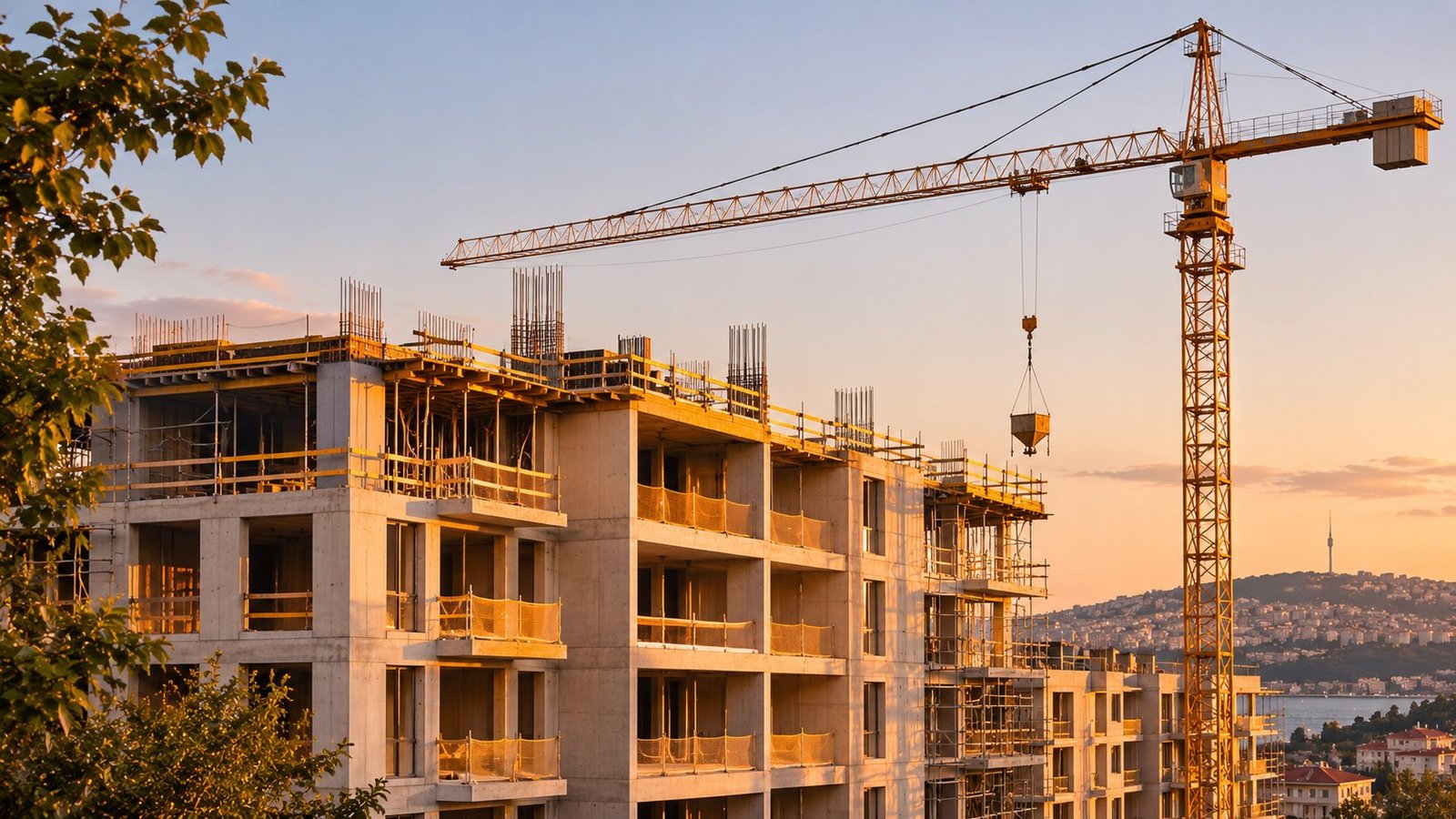
Land, labour and material costs feed into new-build prices, and urban renewal is replacing older stock in many districts. New supply near transport lines and in earthquake-resilient buildings is likely to remain in demand.
Rules for foreign buyers
Thresholds for residence and citizenship, valuation rules and short-term rental regulation all shape foreign demand. Since 29 September 2026, for example, valuation reports for title deed transactions remain valid for 12 months; see valuation reports.
Scenarios rather than forecasts
| If… | Likely effect on buyers |
|---|---|
| Rates fall and credit eases | More domestic buyers; stronger demand for mid-market homes |
| Inflation stays above price growth | Further real declines; better negotiating room |
| Lira weakens sharply | Lower prices in foreign-currency terms; more interest from foreign buyers |
| New supply rises near transport | More choice; pressure on older stock in the same areas |
None of these is a prediction. They are a way to test a purchase against conditions you cannot control. Buy a property you would be content to hold through a weaker market, and avoid paying for growth that has not happened yet.
Who is buying
Foreign demand has shifted over the past few years. In 2025 the largest groups of foreign buyers were citizens of Russia (3,649 homes), Iran (1,878) and Ukraine (1,541), according to TÜİK. In September 2026 the leading nationalities were Russia (388), Iraq (166) and Germany (162). Domestic buyers still account for nearly all transactions, so local incomes, credit and rents matter far more to prices than foreign demand does. First-hand homes made up about a third of sales in 2025, a share that held up better than resales in 2026 as new projects came to market.
What this means in practice
- Base decisions on the building and location, not on the market cycle.
- Compare recent transaction evidence and the licensed valuation with the asking price.
- Allow for currency movements if you earn in another currency.
- Plan to hold for at least five years where possible; sales within five years of purchase can trigger capital gains tax.
To compare cities, read best places to buy property in Turkey; to weigh the advantages and risks, read our look at the risks and benefits of buying. For a property-level view, our property search service can prepare comparable-sales evidence for a shortlist.
Frequently asked questions
Will property prices in Turkey go down in 2026?
Nobody knows for sure. Measured in lira, prices were still climbing in September 2026, while in real terms the TCMB index was 5.7% lower than a year earlier.
Is the Turkish property market slowing?
Sales were 7.2% lower year on year in January–September 2026 after a record 2025, while mortgaged sales rose 24.7%.
How many foreigners buy property in Turkey?
TÜİK recorded 15,308 sales to foreigners in January–September 2026, about 1.4% of all home sales.
What affects Turkish house prices most?
Interest rates and credit, inflation and the lira, construction costs, new supply and the rules for foreign buyers.
Are rents still rising in Turkey?
TCMB’s new-tenant rent index rose 26.6% year on year in September 2026 in nominal terms.
Is now a good time to buy property in Turkey?
That depends on your timeframe and the property. Real price declines can improve negotiating room, but buy only what you would be content to hold through a weaker market.
Where can I check the latest figures?
Each month TCMB updates its house price index and TÜİK releases its home sales figures.